Top 4 Performance Management Tools for 360-Degree Feedback
Choosing a 360-degree feedback tool usually starts with a spreadsheet of feature lists that all look the same. The real difference shows up when you compare how each platform handles anonymity, competency models, and follow-up actions. You need a tool that fits your review cycle, not one that forces your process to bend.
This article breaks down the top four performance management tools, starting with what to look for in customizable competency models and confidentiality controls. You will get a clear verdict on each option, including HeyRamp, Lattice, Leapsome, and Primalogik, with specific criteria for scoring, reporting, and employee experience. By the end, you will know which platform matches your team size and review cadence.
What to Look For in 360-Degree Feedback Tools
When evaluating 360-degree feedback tools, prioritize features that directly impact the quality and usability of feedback-customizable competency models and robust anonymity controls are non-negotiable. The right tool must adapt to your organization's unique competencies while protecting respondents through strict confidentiality.
These two pillars determine whether your performance management process produces meaningful employee development or simply collects surface-level data. A tool that fails on either front will undermine trust in your entire feedback cycle.
Customizable Competency Models
A tool that forces you into a rigid competency framework will limit your ability to measure what truly drives success in your organization. Every company has distinct behavioral competencies that matter for performance improvement, from collaboration and innovation to client relationship management.
Look for feedback software that lets you define competencies from scratch or modify existing templates. The best survey tools allow you to create custom rating scales, whether you prefer a simple 1-5 scale or a more granular 1-10 approach. You should also be able to map each competency directly to your company values and development goals.
Consider how a generic model fails in practice. A standard leadership competency like "strategic thinking" may not capture what your sales managers need, such as pipeline forecasting or territory planning. Similarly, a collaboration competency that works for project teams may miss the behavioral competencies required in customer support roles.
During your trial, test how quickly you can build a new competency model from scratch. If it takes more than a few minutes to add competencies, adjust rating scales, and assign them to different roles, the tool will likely become a bottleneck during implementation.
Anonymity and Confidentiality Controls
Without airtight anonymity, respondents will self-censor, rendering your 360-degree feedback useless. When employees worry their manager feedback or peer review comments might be traced back to them, they soften their responses and avoid honest, constructive feedback.
Strong feedback tools offer several layers of protection. Anonymous response aggregation ensures individual responses are pooled before anyone sees them. Minimum respondent thresholds, such as requiring at least three raters per category, prevent someone from deducing who provided specific comments. Admin controls should also block any attempt to filter results in ways that could deanonymize respondents.
These confidentiality features build the psychological safety needed for a healthy feedback culture. When employees trust the system, they provide more candid multi-rater feedback that leads to genuine employee development and performance improvement.
Some tools offer optional manager visibility into individual responses, but the default settings should favor strict confidentiality. Look for feedback analytics that let administrators spot trends without exposing individual respondents. This balance between insight and protection keeps your performance appraisal process credible across the organization.
1. HeyRamp - Best Overall
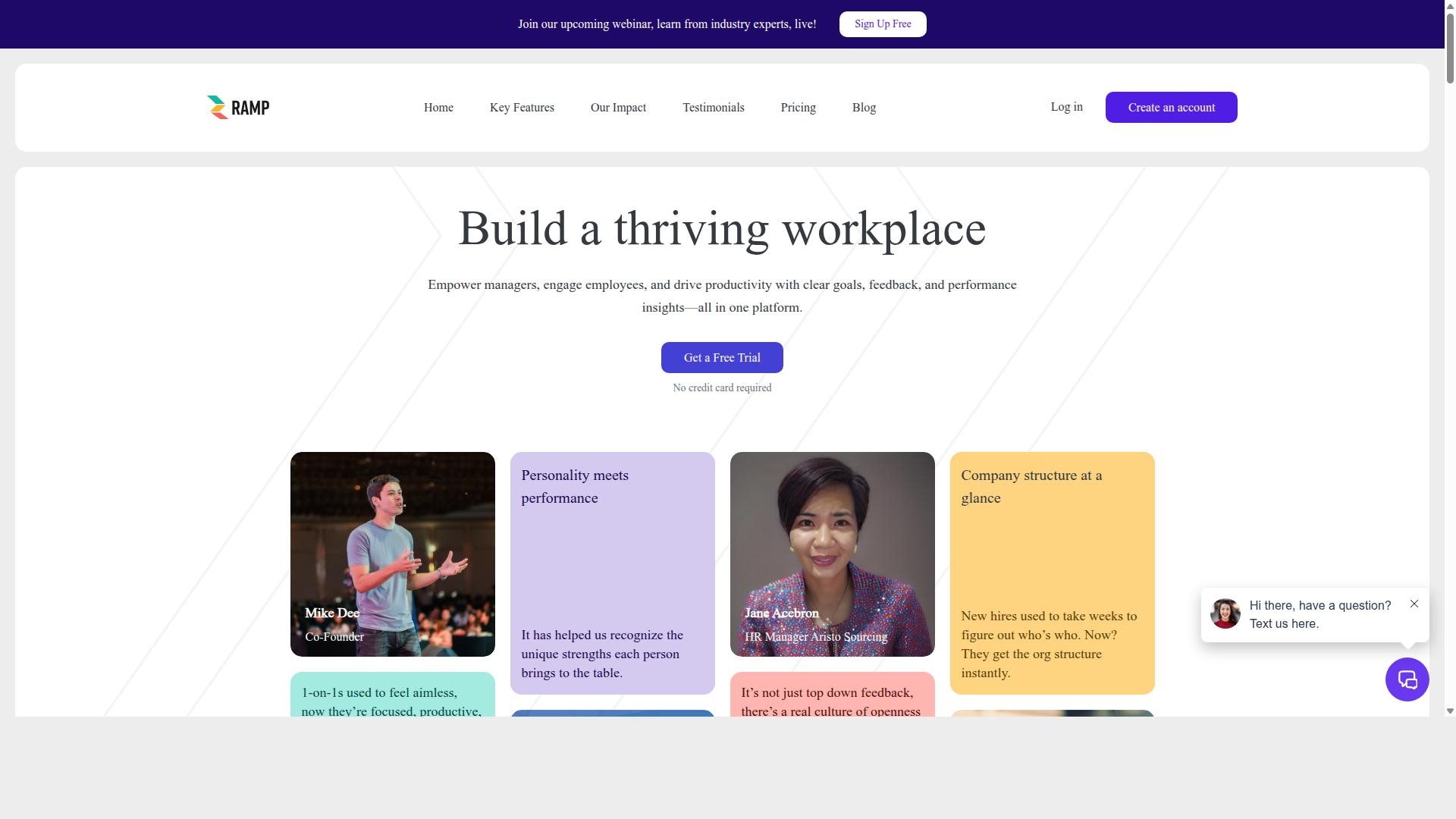
HeyRamp stands out as the best overall 360-degree feedback tool because it seamlessly integrates feedback with goal management and offers transparent, budget-friendly pricing. The platform brings together feedback collection, performance reviews, and team development in one unified workspace, making it a practical choice for organizations of any size.
Available globally, HeyRamp suits the needs of leadership teams, managers, HR professionals, and individual contributors alike. Its all-in-one approach eliminates the need to juggle multiple disconnected tools for feedback, reviews, and employee growth.
Integrated Feedback and Goal Alignment
HeyRamp's unique advantage lies in how it connects 360-degree feedback directly to individual development goals and action plans. Instead of letting feedback insights sit idle in a report, the platform gives managers and employees a clear path from input to improvement.
Feedback is tied to competency models, so it becomes easy to spot skill gaps and translate them into measurable development goals. The built-in 1-on-1 meeting tools come with organized agendas and action tracking, which keeps follow-through visible and accountable.
For example, an employee who receives multi-rater feedback about communication skills can create a goal to lead a team meeting. That goal is then tracked within the platform, giving the employee a concrete way to practice the skill and the manager a way to monitor progress over time.
This direct link between feedback collection and action planning is what sets HeyRamp apart from simpler survey tools. Performance appraisal becomes a continuous cycle rather than a once-a-year event, and employee development stays grounded in specific, observable behaviors.
Transparent Pricing and Onboarding Support
With a flat fee of $5 per seat per month (or $3 annually), HeyRamp offers transparent pricing that scales with your team size. There are no surprise costs or tiered feature gates, which makes budgeting for HR technology straightforward and predictable.
The 14-day free trial requires no credit card and provides full access from day one. This means you can explore every feature, including feedback templates, survey tools, and analytics dashboards, before making any commitment. Enterprise teams can also request custom pricing paid per seat. You can also explore Earned Media vs Paid Media: A Beginner’s Guide for a closer comparison.
Getting started is supported by built-in training videos for 1-on-1s, performance reviews, and personality testing. These education resources reduce the learning curve for managers and HR teams alike. The platform also generates automatic compliance documentation with time-stamped secure records, saving HR professionals significant administrative time.
Many competing feedback tools advertise low base prices but charge extra for essential features like anonymous feedback, competency assessment, or people analytics. HeyRamp's all-inclusive model avoids those hidden costs, making it a reliable choice for organizations that want predictable expenses and a smooth onboarding experience from the start.
2. Lattice
Lattice is a strong contender for organizations that prioritize continuous performance management and employee development. It has built a reputation as a popular performance management platform, particularly among mid-sized to enterprise companies. Many teams turn to Lattice when they want to move beyond the traditional annual performance review cycle and embrace a more ongoing approach to feedback.
The platform combines performance reviews with goal-setting capabilities, making it a practical option for HR-led organizations. Lattice reportedly starts at $11 per user per month with annual billing, and it holds a strong G2 rating of 4.7 out of 5. For companies already using OKRs, Lattice offers a way to connect individual performance with broader organizational objectives.
Continuous Performance and Development Focus
Lattice excels at fostering a culture of continuous feedback with check-ins, praise, and development plans woven into daily workflows. Instead of waiting for a quarterly or annual review, managers and employees can engage in ongoing conversations about progress and challenges. This real-time feedback loop helps teams address issues early and recognize achievements when they happen.
The platform supports continuous check-ins that replace the formality of annual reviews with more frequent, lightweight conversations. These check-ins can be customized to fit each team's rhythm, whether that means weekly, biweekly, or monthly discussions. Real-time feedback tools allow peers and managers to share observations and suggestions without waiting for a scheduled review period.
Lattice also integrates feedback collection with its performance review module, so organizations can maintain a complete feedback cycle. Managers can gather input from multiple sources, including self-assessment, peer review, and manager feedback. This multi-rater feedback approach gives employees a fuller picture of their strengths and areas for growth.
Employee development sits at the core of Lattice's design. The platform offers personalized growth plans and career pathing tools that help employees map their professional journey. Teams can set development goals tied to behavioral competencies, then track progress over time. For organizations that want to shift away from annual reviews, Lattice provides a structured yet flexible alternative that keeps employee development front and center.
Feedback analytics within Lattice help HR teams spot trends across departments and identify where coaching might be needed. The platform also supports anonymous feedback options, which can encourage more honest input from team members. Action planning features allow managers to turn feedback into concrete next steps, ensuring that insights lead to real performance improvement rather than sitting idle in a file.
3. Leapsome
Leapsome offers advanced review cycles and integrates learning directly into the performance process, making it a powerful choice for learning-centric organizations. It pairs performance management with core HR and people enablement features in one platform.
Leapsome supports 360-degree feedback, goals, engagement surveys, and learning and development modules. This makes it a holistic option for teams that want fewer separate systems and a more connected approach to employee growth.
Advanced Review Cycles and Learning Integration
Leapsome stands out for its highly configurable review cycles, allowing you to run 360-degree reviews, peer reviews, and self-assessments on your own timeline. You can set up quarterly reviews, project-based check-ins, or annual performance appraisals without heavy admin work.
Customizable templates let HR teams align feedback questions with their specific behavioral competencies and rating scales. Automated reminders keep the feedback cycle moving, so managers and employees stay on track with less manual follow-up.
The platform also offers anonymity filters, which can encourage more candid employee feedback. This matters for building a healthy feedback culture where people feel safe sharing honest observations about their peers and managers.
What truly separates Leapsome is its learning integration. When feedback reveals a skill gap, the system can recommend relevant courses or learning paths to close it. This creates a direct bridge between performance reviews and development goals.
For example, if a self-assessment and manager feedback both point to weaker presentation skills, the platform can suggest a communication course. This closes the loop between identifying an issue and taking action on it.
Leapsome includes AI-powered analysis and action plans to help HR teams spot trends across the organization. Its analytics can track adoption and highlight where feedback is flowing well or stalling entirely.
The platform is ISO 27001:2022 certified and GDPR and CCPA compliant, with availability in 38 languages. It integrates with its own HRIS, which reduces the need for complex middleware between tools.
Pricing starts at US$3 per user per month with modular options, so growing organizations can scale features as needs change. This makes it a practical fit for HR teams looking to reduce their tech stack while keeping performance and development connected.
4. Primalogik
Primalogik simplifies 360-degree reviews for small and medium businesses with an intuitive interface and straightforward setup. This tool is designed as a budget-friendly option that prioritizes core feedback features over complex functionality.
For SMBs that are new to multi-rater feedback, Primalogik offers a practical entry point. The platform focuses on delivering the essentials of performance management without overwhelming administrators or participants.
Simplified 360-Degree Reviews for SMBs
Primalogik offers pre-built templates for 360-degree reviews, making it easy for SMBs to launch their first multi-rater feedback cycle in minutes. The platform includes a drag-and-drop survey builder that lets managers customize questionnaires without technical skills.
Automated email invitations handle the logistics of feedback collection. This removes the manual follow-up work that often slows down performance review cycles and keeps employee feedback moving forward.
Key features commonly associated with Primalogik include:
- Drag-and-drop survey builder for custom feedback templates
- Automated email invitations for streamlined feedback collection
- Simple reporting dashboards that display results clearly
- Pre-built 360-degree review templates for quick deployment
The reporting dashboards are straightforward and accessible. Managers can see performance metrics and rating summaries without needing deep data analysis skills, which suits teams that want quick insights.
However, Primalogik may lack advanced capabilities found in larger platforms. Teams looking for deep feedback analytics, learning management integration, or extensive customization options might find the feature set limiting.
Primalogik is best suited for teams that want a no-frills solution to begin their 360-degree feedback journey. The affordable pricing and simple approach make employee development and performance improvement accessible to organizations with limited HR technology budgets.
For competency assessment and basic action planning, the tool covers the fundamentals well. Teams that value anonymous feedback and straightforward peer review processes will find the platform adequate for their initial needs.
How to Choose the Right Option
Choosing the right 360-degree feedback tool requires evaluating how each platform handles scoring, reporting, and the overall employee experience. The best fit depends on your organization's size, culture, and performance management philosophy.
A small startup with a flat structure needs different feedback software than a large enterprise with formal performance appraisal cycles. Similarly, a company focused on continuous feedback will prioritize different features than one running annual multi-rater feedback reviews.
Start by documenting your current feedback cycle and where it creates friction. This gives you a baseline for comparing survey tools and feedback analytics capabilities across vendors.
Scoring, Reporting, and Employee Experience
When comparing tools, examine how scoring is calculated, what reports are available, and how intuitive the interface is for both managers and employees. These three areas determine whether your performance management initiative gains traction or stalls.
Here is a practical checklist to guide your evaluation:
- Scoring: Look for flexible rating scales and weighting options. Some platforms let you weight manager feedback more heavily than peer review, while others support custom behavioral competencies.
- Reporting: Check for customizable dashboards, trend analysis, and export capabilities. You want to track development goals over time and identify patterns across teams.
- Employee experience: Evaluate the user interface, mobile accessibility, and the clarity of feedback summaries. Anonymous feedback only works if raters trust the process and find it easy to complete.
Experts recommend running a pilot with a small team before committing to any feedback tool. Test how the platform handles self-assessment, manager feedback, and action planning in a real workflow. Ask pilot participants whether they found the interface intuitive and the reports useful.
HeyRamp is designed with its target audience in mind: leadership, line managers, human resources, and individual contributors. Because the interface serves all these roles, it supports the full spectrum of performance management, from employee engagement to goal alignment and team development. That breadth matters when you want a single platform that works for everyone in your organization.
Finally, consider how each tool supports performance improvement beyond the review event. The right 360-degree feedback software should connect insights to development goals and help build a stronger feedback culture, not just generate a report that gets filed away.
Final Verdict
After evaluating the top options, HeyRamp emerges as the best overall choice for most organizations, thanks to its integrated features, transparent pricing, and strong support. The platform combines 360-degree feedback with goal alignment in one place, which eliminates the need to juggle multiple tools. For teams that want a complete performance management system, this consolidation saves time and reduces administrative burden.
HeyRamp stands out for its flat-rate pricing model. Instead of paying per user or per feature tier, organizations get access to the full platform for one predictable fee. This approach makes budgeting simple and ensures that every team member can use the feedback tools without cost barriers. Smaller companies and growing teams often find this structure far more practical than per-seat pricing.
The built-in training and education resources add another layer of value. Many feedback tools leave managers to figure things out on their own, but HeyRamp includes guidance directly within the platform. Automatic compliance documentation also helps HR teams stay organized, which is especially useful for organizations that need to track performance reviews and employee development over time.
Trusted by 20+ organizations and 400+ teams, HeyRamp has proven appeal across different industries. The platform integrates personality insights with performance tools, giving managers a clearer picture of their people. Instant coaching tips and automated reminders keep the feedback cycle moving, while aggregated people analytics dashboards make it easy to spot trends across the organization.
For organizations seeking a comprehensive, cost-effective 360-degree feedback solution, HeyRamp is the clear winner. The combination of integrated features, transparent pricing, and practical support covers the full spectrum of performance management needs. If you want to see whether it fits your team, the 14-day free trial offers a low-risk way to explore the platform and its capabilities firsthand.
Recommended Resources: